
While the British came to India in the early 1600s – The “Crown Rule” or the British Raj lasted in India for a solid nine decades. The first few Viceroys of British rule impacted many changes including abolishing the Doctrine of Lapse. This post will walk you through a little known fact that involves our city – Pune.
Lord Lawrence the third viceroy to India put in a condition before accepting his Viceregal office that he should be allowed to spend the hot summer months in the hill station Shimla on account of his ill health. It wasn’t surprising, the British and their love for cooler places in India was perhaps understandable given the infamous British weather they were accustomed to. After all, hill stations, with their thickly wooded hills and the enigmatic mist, gave the British an opportunity to build around themselves a replica of English life inherent to them. In fact many Britishers continued to make Shimla their home even after Indian Independence.
The formal move to make Shimla the “summer capital” was completed in 1864. Once formalised the entire capital administration was migrated to Shimla from the humid Calcutta (now Kolkata). This move caused the exchequer an annual expenditure of a copious sum of INR 4 Lakhs (INR 400 Thousand) which was a rather extravagant expenditure for the eighteen hundreds. Obviously this move didn’t go down well and Lord Lawrence had to continually justify the move. However, despite initial reservations, Simla was the de facto summer capital of India with Lawrence and his successor spending six months a year in the Queen of hills.
Meanwhile the British Raj was toying with the idea to move the capital from Kolkata to a more central and strategic location and perhaps even a healthier city for its officers even before Lord Lawrence had arrived in India. The revolt of 1857 was the tipping point and the need for another capital became more urgent.
This is where Poona (now Pune) came into the limelight. Several cities were under consideration from Jabalpore (now Jabalpur), Allahabad, Agra to even Bombay (now Mumbai). Ofcourse Delhi was selected as the capital in 1911 soon after the Partition of Bengal while the actual move happened in 1931.
‘Salubrious’ Poona:
Lord Lawrence, an advocate and admirer of Shimla’s weather, at the time suggested that instead of moving the capital and thereof the Government out of Calcutta the British Raj should consider making Shimla the permanent summer capital.
It’s in this context, in a letter to Charles Wood, on May 30, 1864. Charles served as the Secretary of State for India at that time.
As an alternative to the summer and winter capital arrangement, Lord Lawrence suggested that the permanent capital of India should be shifted to Poona (now Pune). The letter read: “Next to this arrangement, perhaps the best would be to transfer the Government of India to Poona, which is a salubrious position, and, practically, on the sea-coast. That is to say, it is only eighty miles distant, and connected by railway with Bombay.”
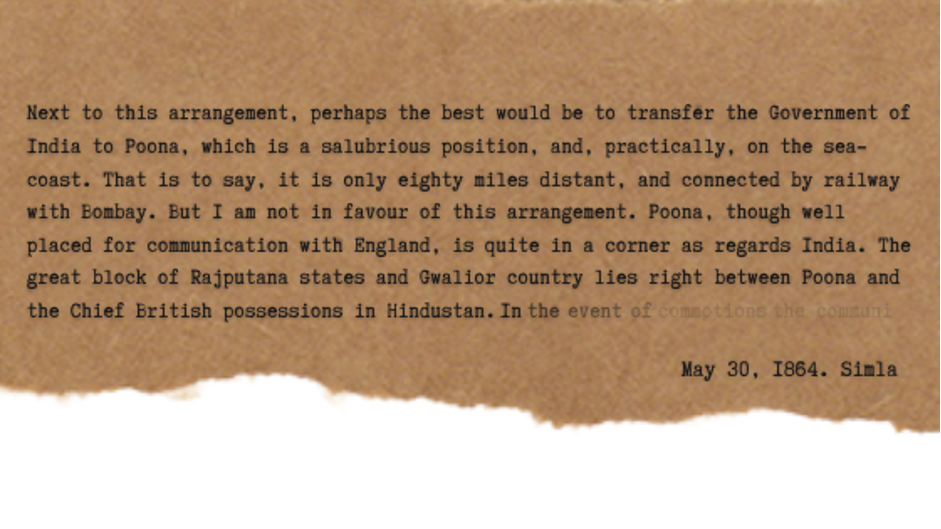
Poona got edged out of the running, because the British felt it was not centrally located and could potentially be cut-off from the rest of Hindustan in any eventuality.
Pune’s location is still perhaps it’s vantage point. Neatly tucked away amidst the Sahyadris, gorgeous weather for most part of the year and easy accessibility to Mumbai and decent connections from Pune itself. Pune is soon earning its “Metro” city status. Pune was a power centre as Shaniwar wada was the seat of the Peshwa rulers of the Maratha Empire till 1818. I wonder if Pune would have this wonderful charm about itself if it was indeed the capital city of the British Raj. Capital city or not, Pune is definitely the “Queen of the Deccan” and the cultural capital of Maharashtra!
 Pune Metro