
I recently read an article that had details around how the Pune Mumbai journey will in the near future be possible in 90 minutes thanks to the Mumbai Trans Harbour Link!! Unreal. I mean, you could have lunch with your bestie in Mumbai and be back in Pune for your evening walk or gym session!
That got me thinking about this journey in the British era and I discovered some fascinating facts. The treacherous Bhor Ghat made travel between Mumbai and Pune an arduous affair. Those of us who knew life before the expressway know that the drive on Bhor Ghat was always a tricky affair.
In the early 19th century, people travelling between the twin cities had to use palanquins, carts or horses to traverse the plains. In the said times, your choice of the mode of transport often reflected your social status. A mini boat ride would then lead to a multi-mile trek on the Bhor Ghat.
The memoirs of the Bishop of Calcutta, Reginald Heber describes in detail his travels and experiences of the journey on Bhor Ghat in 1825. Pune was then known as “Poonah”, in his own words, he describes how this three day long ‘Journey to Poonah’ was full of back-breaking hardships and sleepless nights but also with unforgettable encounters with the natural beauty of the Western Ghats.
“…the ascent (of Bhor Ghat is) very steep so much so that, indeed, a loaded carriage, or even a palanquin with anybody in it, could with great difficulty be forced along it. In fact, everyone either walks or rides up the hills, and all merchandise is conveyed on bullocks or horses,” wrote Heber in the posthumously published memoirs ‘Narrative of a Journey through Upper Provinces of India’, edited by his wife Amelia.
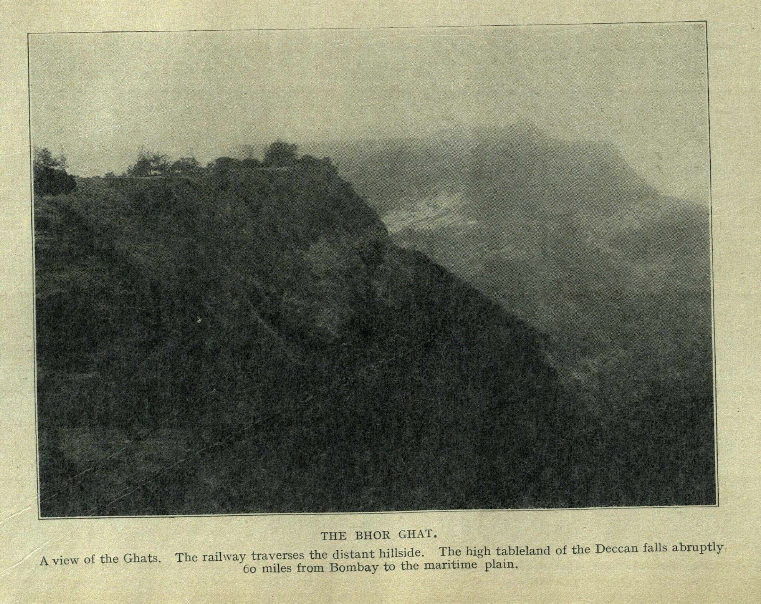
Heber and his associate reached Pune Cantonment after an overnight sleepless journey in which Heber experienced alternate spells of “heat and shiver”. His memoirs are quite the read, I have linked the eBook in the article for those who would like to experience the book first hand.
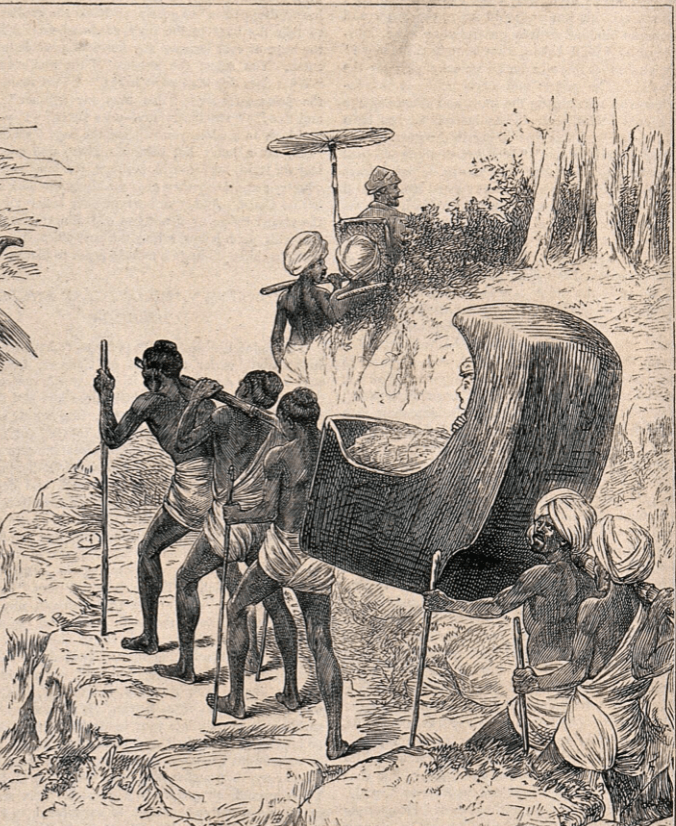
While Heber’s journey to Pune was challenging, the difficulties faced by those travelling this route in the early 1800s was far more of an ‘uphill task’ both figuratively and literally. The turning point to make Bhor Ghat navigable was two humiliating debacles the East India Company faced in the First Anglo-Maratha War (1775-1785). The battle defeats, as per the British, were largely due to the lack of a reliable transport and communication link to Mumbai through the great impediment of the Ghat.
Lieutenant Colonel E W C Sandes recounted in the book ‘Military Engineer in India’ (Vol II):
“…It was not until 1803, that the first impetus to the British road construction was given by Colonel Arthur Wellesley, afterwards Duke of Wellington, when he set his military engineers and pioneers to construct a fair-weather road up the Bhor Ghat to facilitate the reinforcement and supply of his armies in the Deccan during the Second Maratha War. This road helped materially towards the success of Wellesley’s operation, but afterwards fell into disuse and was destroyed by the Peshwa,”
Communications between Bombay and the interior were greatly improved between 1819 and 1827 by Governor Mountstuart Elphinstone, who decided to reconstruct Wellesley’s road up the Bhor Ghat. Bishop Heber had also travelled on the road after it was freshly repaired and had great praise for the work done by Elphinstone.
The next big improvement in travel for this region came four decades on, in 1863, when the Great Indian Peninsular Railway (GIPR) inaugurated its Bombay-Poona train service that brought down the travel time between the two cities to just a few hours. Work on the project was preceded by a great amount of hesitancy given the near-insurmountable challenge posed by the Bhor Ghat.
The efforts, investment, technological innovations and lives that were spent in making the Mumbai-Pune railway line through the Bhor Ghat, is often described as one of the most remarkable achievements of 19th century civil engineering.
Many of us have had unforgettable drives and train rides on the Mumbai Pune route. Who would have thought the unmotorable and unnavigable Bhor Ghat would one day be at the heart of the most scenic and comfortable road journeys one can undertake in India. There were three major turning points that made this journey remarkable and faster. One in 1928 when the reversing station located near the summit of the hill was removed and a few more tunnels added. Then two years later, in 1930 when Deccan Queen, India’s first super fast train, would chug along the route once unsuitable even for bullock carts. The third and most recent one came in 2002 when the massive six-lane Expressway was made operational. These developments boosted trade and commerce activities in the region but more importantly had all of our hearts swell with pride on our nation’s achievements. Who would have thought a war fought over 200 years ago, would help us realise the value of good road connectivity.
 Pune Metro