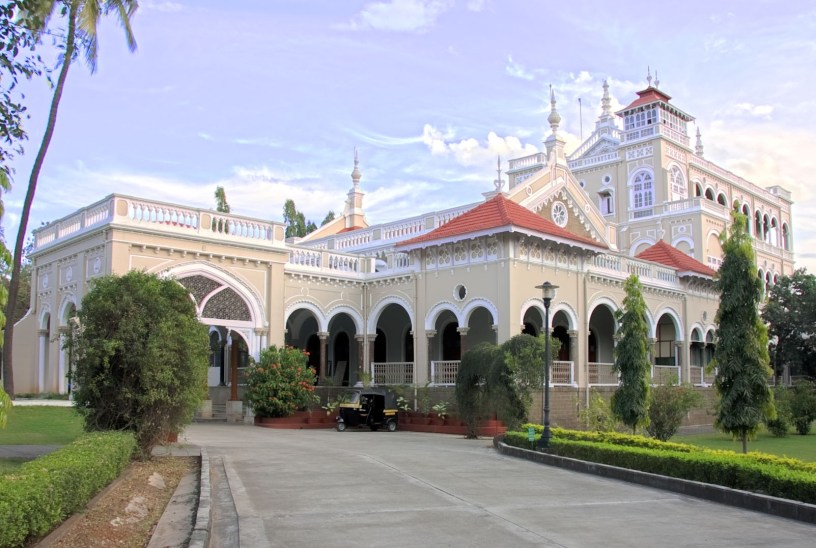
Whether you’re a history buff, a believer of Gandhian philosophy, appreciate good architecture or simply a proud Indian, a visit to the Aga Khan Palace on Nagar Road should be on your top must-visit place in Pune. I guarantee, a walk in the corridors of this historic place will have your hearts filled with awe.
Nestled in a tony neighbourhood of Kalyani Nagar, just off the busy and arterial Nagar road, this palace built in 1892, is a sight to behold. A clean, well-maintained palace and campus, with manicured lawns welcomes one as soon as you drive in through the gates. What unfolds after you enter the gates of history will leave you speechless.
Palace History and Architecture
The Aga Khan Palace was built by Sultan Muhammed Shah Aga Khan III. The Sultan, who was the Imam (spiritual leader) of the Nizari Ismaili Muslims built the palace as an act of charity. He wanted to help the poor in the neighbouring areas of Pune, who were drastically hit by famine.
The architecture of the palace is primarily of Islamic style, one can see Italian influences in the Italian arches and French influence on the beautiful lawns. This three-storied building consists of five halls featuring long corridors, wooden french windows, large and spacious verandahs. The floors are marbled with old-style tile designs, doors with gorgeous mahogany wood, and windows with beautifully patterned old rustic cast iron grills that have an unbeatable old world charm.
National Importance
The Aga Khan Palace has been a witness to India’s struggle during the Independence movement. After the Quit India Movement in 1942, Mahatma Gandhi, Kasturba Gandhi, Gandhiji’s trusted aide Mahadev Desai, Miraben, Sarojini Naidu, and other eminent freedom fighters were placed under house arrest here. While our history textbooks mention this, the palace and its history got noticed in the Richard Attenborugh movie, ‘Gandhi‘. In fact certain scenes in the movie ‘Gandhi’ were shot here!
Aga Khan IV handed over the property to India in 1969 as a token of respect for Mahatma Gandhi and his ideologies. Thereafter, the palace was turned into a museum and was made the headquarters of the Gandhi National Memorial Society. In 2003, the palace was declared a place of national interest and has since then been under the care of the Archaeological Survey of India (ASI).
History behind the Palace – A Personal loss to Gandhiji
One of the turning points in the Indian freedom struggle is pivotal to understand the importance of the Aga Khan Palace. At the All-India Congress Committee session in Bombay, Gandhiji launched the ‘Quit India’ movement on 8 August, 1942. Gandhiji addressed a massive gathering and gave the nation the famous slogan – ‘Do or Die’. The very next day, as Gandhiji finished his morning prayers, the police commissioner came with a warrant and arrested him and other prominent leaders.
After the arrests, Gandhiji along with the freedom fighters and leaders were brought to Pune by train. Some were detained at the Yerwada Jail, while some were confined to the court in Ahmednagar. On 10 August, 1942, Gandhiji along with his wife, secretary and some other freedom fighters were brought to the Aga Khan Palace and kept under house arrest for 21 months. While Satyagraha and the Quit India Movement gained momentum in the days after their arrest, these 21 months at the Aga Khan Palace saw Gandhiji face two of his most harsh and personal losses.
Gandhiji’s secretary, Mahadev Desai passed away due to a heart attack on 15 August, 1942, just five days after being brought to the Aga Khan Palace. His wife and constant companion of 61 years (married in 1883), Kasturba passed away here as well on 22 February, 1944. She suffered from chronic bronchitis and after two heart attacks she breathed her last at these very grounds.
A very interesting read in the book, ‘Ba and Bapu‘ states how Kasturba’s last detention at the Aga Khan Palace took a toll on her health, especially because they had been so suddenly swooped down upon. This detention was unlike the ones previous occasions, as in this arrest, they were not informed how long they will be detained.
What you will find here
Museum
The campus houses a museum depicting Gandhiji’s life and philosophy. Apart from documents written and signed by Gandhiji, books read by him, paintings from renowned artists like SM Pandit, MR Acharekar, the most interesting and intriguing part of the museum are the personal artefacts, utensils, slippers and others that were used by Gandhiji and Kasturba. The museum has even preserved a room where Gandhiji and Kasturba used to sleep – it’s like taking a ride in a time machine and seeing a glimpse of the life that Ba and Bapu lived.
Samadhi
Across the main palace building, beyond the gardens, there are signs that will lead you to the Samadhi (memorial) grounds. There are samadhis of Gandhiji, Kasturba and Mahadev Desai here. A small area and even smaller samadhis but one that evokes profound emotion.

Gardens
The palace gardens are lush green and an inviting place to relax and soak in the rich history this place has to offer. A great place to have stimulating conversations like perhaps Gandhiji did back in the day. There is a cute water fountain in the gardens should you need to grab a few sips of water or take a selfie!
Other interesting things
You can also explore the Khadi and Handloom Textiles Shop, Library and Documentation centre where one can buy books on Gandhiji’s philosophy, Kasturba Mahila Khadi Gramodyog Vidyalaya, and other training centres.
Getting There
The palace is on the arterial Nagar road. Between the two entry points into Kalyani Nagar (Ramwadi entrance and Shastri Nagar entrance). Hard to miss colonial grand white iron gates! It’s very close to the Pune Airport. If you’re making a trip especially to this side of town you can combine your visit to the Aga Khan Palace and Phoenix Marketcity or the Airport Road Nursery depending on your areas of interest.
Timings
They are usually open all seven days a week from 9:30 am to 5:30 pm. Timings may vary on days like Gandhi Jayanti, Martyrs Day, Independence Day.
 Pune Metro